

What happens when a business unit asks its GCC for twice as much support, the budget barely changes, and nobody can tell whether that demand is strategic or simply unpriced?
That are central to evaluating how a GCC should operate and where it creates value. . How a Global Capability Center (GCC) is funded shapes how business units consume services, how leaders perceive value, and whether the center is treated as a strategic capability or another cost center. For a GCC consultancy, these funding dynamics are central to evaluating how a GCC should operate and where it creates value.
This article walks through the four funding models GCC leaders use, how each one changes demand and accountability, the data you need before setting a price, the most common ways chargeback fails, and how governance keeps the model working over time.
Start With the Question: What Behavior Should Your GCC Funding Model Create?
Every funding model sends a message. A centralized model treats GCC capacity as a shared enterprise resource, which can encourage adoption but may also make consumption feel free. Usage-based charging creates stronger demand signals, but can discourage adoption when applied too aggressively.
The question is not which model recovers the most cost. It is which model encourages the behavior the enterprise wants from its GCC :wider adoption, better demand discipline, or clearer accountability.
A GCC consultancy should assess funding as part of the GCC’s intended role, rather than treating chargeback as a standalone finance exercise.
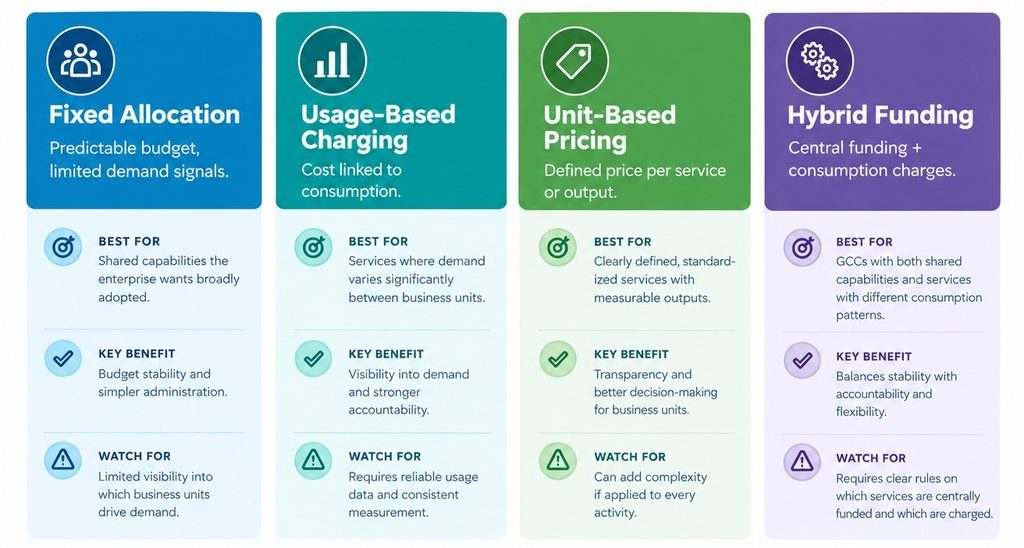
Four GCC Funding Models Can Create Very Different Incentives
No single model works for every GCC. The right approach depends on the center’s role, service consumption, cost structure, and desired behavior.Getting this right also sharpens how a GCC’s economics compare with GCC outsourcing services when leadership weighs build versus buy.
Fixed Allocation
The enterprise gives the GCC a defined budget, often based on headcount, revenue, or business-unit size.
Neo’s GCC engagements show why the role of the center needs to come first. If the center is building enterprise capabilities such as platforms, architecture, security, or governance, forcing every business unit to pay for consumption can undermine the investment case.
But when the same model funds highly variable services, it can hide demand and make capacity planning harder. Fixed allocation should be judged less by whether it recovers cost and more by whether it supports the GCC’s intended role.
Usage-Based Charging
Business units pay based on consumption, such as transactions, tickets, applications, or infrastructure usage.
At Neo, we test whether the consumption metric actually helps leadership make a better GCC decision. A metric may look objective but still distort economics if it does not reflect the underlying cost or complexity of delivery. A GCC consultancy can help determine whether the metric creates useful demand visibility without unnecessary complexity.
Unit-Based Pricing
The GCC sets internal prices for defined services or outputs. Neo’s proprietary data and benchmarks from GCC and sourcing engagements provide a broader reference point for internal pricing. A GCC may calculate its cost per transaction accurately and still lack a reference point for determining whether that cost is competitive or sustainable.
Internal pricing becomes more useful when it helps leadership understand GCC economics alongside available alternatives. This gives decision-makers a clearer basis for evaluating whether the current pricing model supports the GCC’s role and the enterprise’s broader sourcing choices.
Hybrid Funding
Core capabilities are funded centrally, while variable services carry consumption-based charges.
As GCCs evolve beyond a simple shared-service structure, Neo often considers where a hybrid approach can create clearer funding signals. Enterprise capabilities may require central investment, while discretionary or variable services need stronger demand signals.
The funding model should reflect those differences rather than forcing every GCC service into the same commercial construct.
When Chargeback Changes Demand
Chargeback can change how business units behave, even when the underlying service remains the same. Pricing can improve demand discipline and make capacity requirements easier to discuss. But excessive charges or detailed allocations can cause business units to delay adoption, challenge costs, or seek workarounds.
NeoGroup treats internal pricing as a behavioral mechanism, not simply a cost-recovery tool. The objective is to create signals that encourage better decisions about consumption and capacity. This is where a GCC consultancy can add value by looking beyond the pricing formula to understand whether the model is creating the right behavior or unintentionally slowing strategic adoption.
What Should Be Funded Centrally?
Not every GCC service needs the same funding approach. Foundational capabilities such as enterprise architecture, security, shared platforms, and governance often benefit the organization broadly. Charging business units for every activity can create friction, while variable services may need clearer consumption signals.
These can include:
- Transaction processing: Costs vary with volume.
- Application support: Demand differs across business units.
- Specialized analytics: Usage depends on specific requirements.
Neo’s Core vs Context lens provides a way to make this distinction within the broader global capability center operating model. The framework separates capabilities that are strategically important to the enterprise from services where consumption and cost should play a larger role in funding. This helps GCC leaders determine what should be funded centrally and where business units should receive a clearer financial signal.
Before Setting a Price, Fix the Measurement Problem
A chargeback model is only as credible as the information behind it. Before setting prices, GCC leaders need clarity on:
- The service: What is being delivered?
- The cost driver: What drives delivery cost?
- Consumption: How does demand vary?
- Enterprise objective: Is the priority adoption, transparency, discipline, or investment?
Neo separates three numbers when assessing GCC economics: the internal cost of delivery, the price charged to business units, and the economics of realistic alternatives. Our 25+ years of proprietary data across GCCs, suppliers, locations, pricing, and service performance provide a broader reference point for testing whether an internal price is competitive and sustainable. This helps leadership determine whether pricing simply recovers cost or supports better decisions. A GCC consultancy can bring this market view into the discussion.
Why GCC Chargeback Models Fail Even When the Numbers Look Right
A chargeback model can be mathematically correct and still produce poor business outcomes.
- Poorly defined services: Business units cannot tell what they are paying for.
- Weak cost drivers: The formula is easy to calculate but difficult to defend.
- Excessive complexity: Leaders spend more time debating charges than managing demand.
- Poor strategic alignment: Pricing discourages adoption of capabilities the enterprise wants to scale.
- No recalibration: Automation, volumes, and service portfolios change while the model remains static.
Neo’s assessment goes beyond whether the numbers balance. Chargeback needs to be evaluated alongside service ownership, capacity, governance, performance, demand, and sourcing choices. A pricing mechanism can be sound while ownership remains unclear or demand is poorly managed. If these elements are disconnected, changing the allocation formula rarely fixes the underlying problem.
A GCC consultancy should evaluate the behavior created by the model, not just whether the numbers balance.If any of this sounds familiar, an outside view usually surfaces the gap faster than another internal review. Talk to NeoGroup about your GCC funding model.
Governance and the Annual Reset
Putting a funding model in place is not the end. GCC leaders need to monitor demand, capacity, service quality, costs, and business-unit behavior over time.For Neo, an annual funding review is not simply a price reset. Changes in demand, automation, service performance, GCC scope, and market economics can signal that the model needs to change.
A service may develop predictable unit economics, while a discretionary capability may become enterprise-critical. A GCC that has materially expanded its scope may also need a different funding structure. Clear ownership should cover pricing changes, exceptions, disputes, allocation decisions, and annual recalibration.
For organizations building a GCC playbook, funding should connect with governance and the broader global capability center operating model. A GCC consultancy can help structure this annual reset.
How Do You Choose the Right Funding Model for Your GCC?
GCC leaders can simplify the decision by asking:
- What behavior do we want to encourage?
- Which capabilities are strategic enterprise investments?
- Where does consumption vary materially?
- Can we measure consumption reliably?
- Can the model be governed without excessive complexity?
Neo adds a sixth question: What would this capability cost, and how would it perform, if the enterprise sourced it differently? This does not assume GCC outsourcing services are better than internal delivery. It means comparing internal costs, external economics, transition requirements, control, talent, quality, intellectual property, and strategic value.
As the only pure buy-side sourcing advisor in the US market, Neo has no supplier fees, referral fees, or research payments influencing that assessment.
The Right Funding Model Should Shape Better GCC Behavior
A GCC funding model is not simply a mechanism for recovering costs. It shapes how business units consume services, prioritize demand, and make investment decisions.
The right model should balance cost recovery with the GCC’s role, service economics, demand patterns, and the behavior the enterprise wants to encourage. It should also evolve as the GCC expands its capabilities, changes scope, or adopts new technologies.
For organizations building a GCC playbook, funding should connect with governance, service performance, demand management, and sourcing choices. A GCC consultancy can help bring these factors together and turn funding from a finance exercise into a practical operating decision.
Looking to redesign your GCC funding model? Talk to NeoGroup to build one that drives the demand discipline and accountability your business units actually need.


